
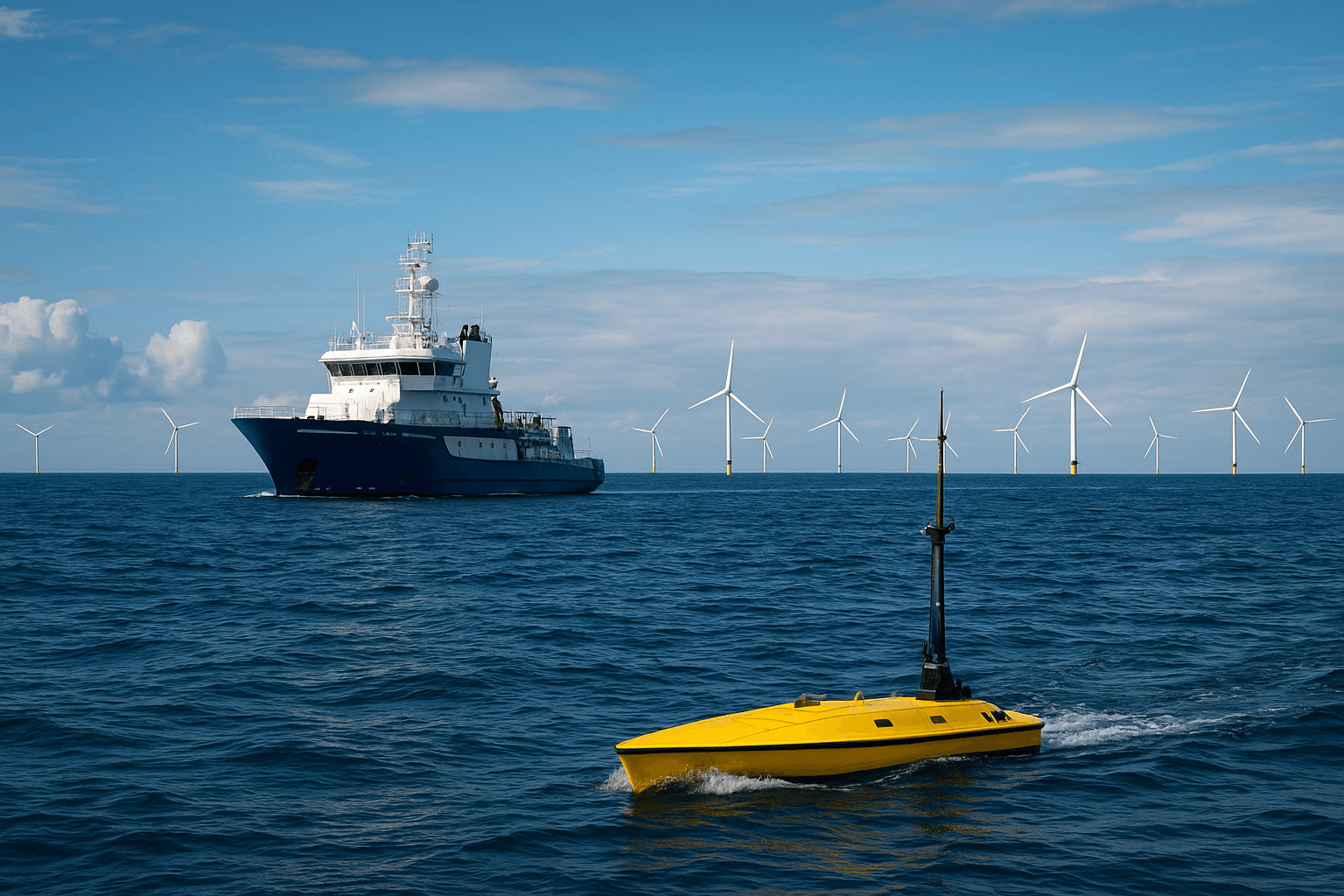
As maritime activities evolve—from hydrographic surveying to offshore energy maintenance—traditional GNSS alone is no longer sufficient. Harsh sea conditions, multipath reflections, magnetic disturbances, and GNSS signal outages all challenge navigation stability.
High-precision inertial navigation system(INS) provides the reliability needed to ensure that vessels and unmanned platforms operate safely and accurately in demanding marine environments.
⚓ Hydrographic Surveying & Marine Mapping
For both manned survey ships and USVs, high-quality motion data is critical for:
🟢 High-resolution seabed mapping
🟢 Accurate heave / roll / pitch compensation
🟢 Stable navigation during GNSS degradation
🟢 Long-endurance autonomous survey missions
INS helps maintain smooth trajectories and consistent data quality even when GNSS performance fluctuates due to waves or coastal interference.
🛢 Offshore Energy & Industrial Operations
In environments such as offshore wind farms, subsea pipelines, and oil & gas infrastructure:
✔ INS provides continuous positioning during GNSS gaps
✔ Supports precise attitude control for ROV/AUV deployment
✔ Reduces operational interruptions caused by weather and sea state
✔ Improves overall mission safety and data reliability
For operators working far from shore, the ability to maintain stable navigation and accurate motion reference becomes essential.
🌊 A Core Technology for the Next Generation of Maritime Autonomy
As the maritime industry moves toward higher levels of automation—unmanned surface vessels, long-range inspections, and persistent offshore monitoring—high-precision inertial navigation is increasingly becoming a foundational component.
From marine surveying to offshore energy, from environmental monitoring to autonomous surface platforms, INS ensures that every mission is stable, consistent, and dependable even when GNSS cannot.


Add comment