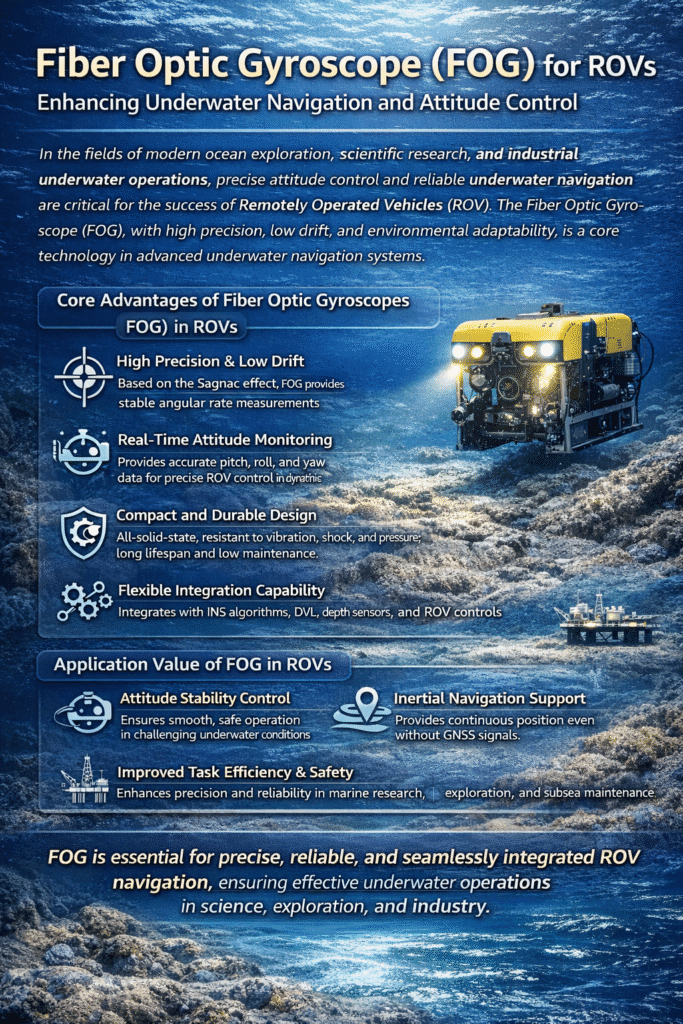
In the fields of modern ocean exploration, scientific research, and industrial underwater operations, precise attitude control and reliable underwater navigation are critical for the success of Remotely Operated Vehicles (ROV). The Fiber Optic Gyroscope (FOG), known for its high precision, low drift, and excellent environmental adaptability, provides robust inertial measurement support for ROVs and has become a core technology in advanced underwater navigation systems.
Core Advantages of Fiber Optic Gyroscopes (FOG) in ROVs
High Precision and Low Drift: Based on the Sagnac effect, FOG achieves extremely low bias instability, maintaining stable angular velocity measurements during long-duration operations or in complex underwater environments. FOG sensors significantly outperform traditional mechanical gyroscopes and MEMS sensors in precision and reliability.
Real-Time Attitude Monitoring: FOG systems provide accurate pitch, roll, and yaw angle data, enabling precise attitude adjustment and stable control of ROVs even in dynamic underwater currents.
Compact and Durable Design: With an all-solid-state structure and no moving parts, FOG devices resist vibration, shock, and pressure changes. Their long lifespan and low maintenance requirements make them ideal for harsh deep-sea environments with high pressure and intense vibrations.
Flexible Integration Capability: FOG sensors easily integrate with ROV control systems, inertial navigation algorithms, depth sensors, Doppler Velocity Logs (DVL), and other devices to form high-performance Inertial Navigation Systems (INS), further enhancing overall positioning accuracy.
Application Value of FOG in ROVs
Attitude Stability Control: Ensures stable operation of ROVs under complex currents or operational disturbances, preventing loss of control and improving operational safety.
Inertial Navigation Support: Provides continuous position and orientation tracking in deep-water regions where GNSS signals are unavailable, making it suitable for long-duration exploration, pipeline inspections, and industrial underwater operations.
Improved Task Efficiency and Safety: FOG technology enhances precision and reliability in marine scientific research, resource exploration, and subsea infrastructure maintenance, reducing operational risks and optimizing mission time.
Current mainstream FOG systems support efficient static gyro compassing, achieving high-precision heading alignment. For high-speed motion or dynamic underwater environments, advanced algorithm integration or fusion with auxiliary sensors can further meet the heading requirements of complex ROV missions.
Conclusion
The Fiber Optic Gyroscope (FOG) is a core technology for modern ROV attitude control and underwater navigation. With high precision, exceptional reliability, and seamless integration features, FOG sensors significantly improve ROV stability and operational efficiency, providing strong technical assurance for marine scientific research, underwater resource development, and industrial subsea applications.


Add comment