
In autonomous vehicles, Inertial Navigation Systems (INS) — often fused with GNSS — deliver exceptional precision in challenging environments where GPS signals falter or vanish.
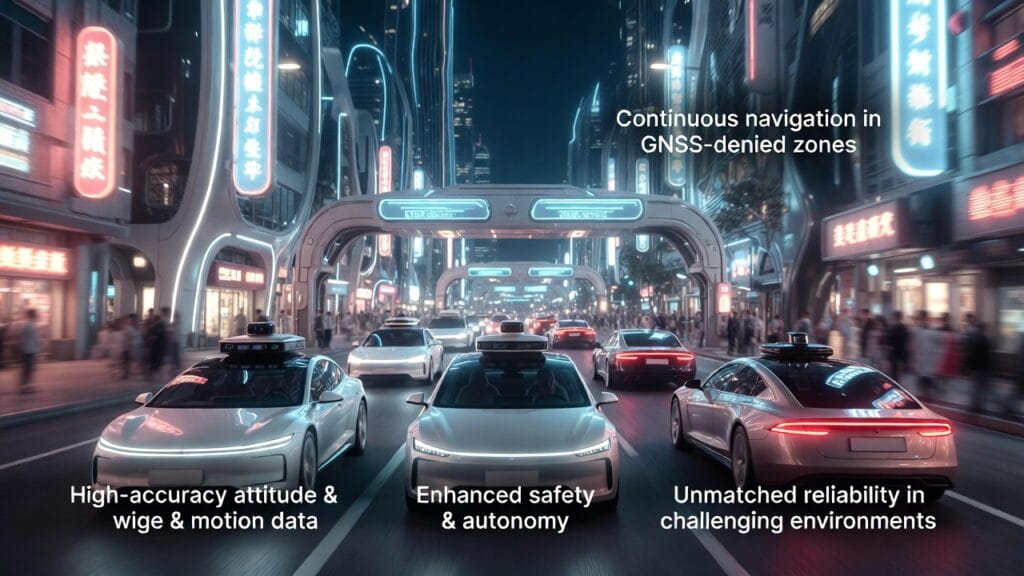
Core Benefits:
- Continuous navigation in GNSS-denied zones — Maintains reliable position, velocity, and attitude during tunnels, urban canyons, parking structures, bridges, or adverse weather/jamming.
- Dead-reckoning resilience — Provides independent, jam-resistant positioning without external signals, bridging GPS outages seamlessly.
- High-accuracy attitude & motion data — Real-time heading, roll, pitch, and speed support precise lane-level localization, path planning, and safe maneuvering.
- Enhanced sensor fusion & stability — Integrates with cameras, LiDAR, and radar for robust perception, reducing drift and improving overall system reliability.
- Improved safety & autonomy — Enables consistent performance under dynamic conditions (rapid acceleration, sharp turns), critical for Level 4/5 autonomy.
Why Use INS in This Sector?
GPS alone is insufficient in real-world urban driving — signal blockages cause errors or complete loss. INS ensures uninterrupted, dependable navigation, minimizing risks and enabling true self-driving capability in complex, unpredictable environments.
Strongest Point:
Unmatched reliability in GNSS-denied environments — INS bridges critical gaps where satellite navigation fails, making it indispensable for safe, scalable autonomous driving.
This technology is a cornerstone for next-generation self-driving platforms, powering companies like Waymo and advancing safer roads worldwide.
#AutonomousVehicles #SelfDrivingCars #INS #GNSS #ADAS #PrecisionNavigation #AutomotiveTech


Add comment